













How AI Engines Actually Rank And Retrieve Content
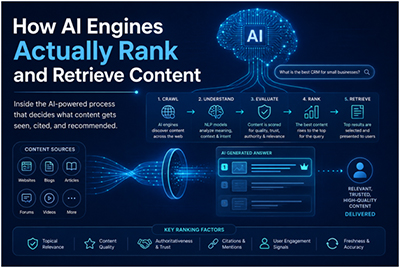
Let me be honest with you about something. When most people start digging into Generative Engine Optimization, they assume it works like a smarter version of Google. They think there must be some ranking algorithm humming away in the background, a list of signals to hit, a way to reverse-engineer what gets surfaced. So they look for the GEO equivalent of backlinks and keyword density, and they end up frustrated when nothing quite makes sense.
That frustration is not their fault. It comes from carrying the wrong mental model into a completely different system. AI engines do not work like search engines. They are built differently, they process information differently, and they make decisions differently. Once you actually understand how they work, a whole lot of things about GEO start clicking into place.
So let us slow down and walk through it properly. Not in a technical-paper way, but in a real, practical way that helps you make better decisions about your content.
When people talk about AI engines, they are actually talking about a mix of very different systems. And those systems get their information in two very different ways.
The first way is what happens during training. A large language model - the kind that powers ChatGPT, Gemini, Claude - learns by reading an absolutely staggering amount of text. We are talking about a significant chunk of the public internet, plus books, research papers, forums, news archives, and more. The model does not memorize all of this word for word. Instead, it develops a deep sense of patterns - which ideas belong together, which brands are associated with which topics, what expertise in a given field actually sounds like. All of that gets baked into the model before it ever talks to a single user.
The second way is real-time retrieval. Tools like Perplexity, Google's AI Overviews, and Bing Copilot do not just rely on what the model already knows. When you ask them a question, they go out and pull fresh content from the web - right now, in the moment - and feed that into the model as extra context. The model then uses both what it already knows and what it just retrieved to put together your answer.
This distinction matters enormously for your strategy, because influencing the first thing requires a completely different approach than influencing the second. If you only focus on one, you are leaving half the opportunity on the table.
Think about what it means for a model to have "learned" about your brand during training. It is not like the model has a database entry with your company name and a list of facts. It is more like... it developed a sense of you. An impression.
If your content was out there, being referenced and cited and discussed across dozens of credible sources before the model's training cutoff, then the model has absorbed that presence. It has built associations. When someone asks about your category, your name comes up in the model's understanding of that space in a natural, confident way.
But here is what most brands do not fully reckon with. If your online presence was thin, inconsistent, or mostly self-promotional before that training cutoff, the model essentially does not know you. It may have encountered your name a handful of times, but it never built real associations between you and the topics that matter to your business. You are a weak signal in a sea of data.
This is why some companies seem to appear in AI answers almost automatically, while others - sometimes genuinely great products or services - are invisible. It is not always about quality. A lot of it comes down to whether the model developed a meaningful impression during training.
The practical takeaway here is uncomfortable but important: if you are starting from a weak position in a model's training data, you cannot fix that overnight. Future model versions will be trained on content being created right now. That is the window you are in. What you publish today, what others say about you today, what gets cited and linked to today - all of that shapes what the next generation of AI engines knows about you.
Now let us talk about the part you have more immediate control over: real-time retrieval.
When someone asks Perplexity a question, the system does not just hand that question to the language model and wait for an answer. It first runs a search, pulls back a set of relevant pages from the web, and passes those pages - or key excerpts from them - into the model's context window. The model then synthesizes all of that into a response.
So the real question is: what makes your page one of the ones that gets pulled?
Here is something that trips a lot of people up. These retrieval systems do not match your content to a query based on whether you used the same words. They use something called vector embeddings, which is a way of converting text into a mathematical representation of its meaning. Two passages can be about exactly the same thing using completely different words, and a vector search will recognize that they are semantically similar.
What this means for you is that writing naturally and thoroughly about a topic - covering the real dimensions of it the way an expert would - is more effective than engineering your content around specific keyword phrases. The system is looking for meaning, not word frequency.
It also means that thin content gets exposed. You can hit all the right keywords and still get passed over, because the system can tell the difference between a page that actually understands the topic and one that is just wearing the right clothes.
Because these AI systems are designed to give people current information, they tend to favor content that has been recently published or meaningfully updated. A page from 2021 on a fast-moving topic is going to lose out to a comparable page updated six months ago.
But here is the nuance: "updated" does not mean slapping a new date on an old post. Retrieval systems can assess whether an update actually added new substance. A genuine refresh - new data, new context, responses to developments that happened after the original publish date - carries real weight. A cosmetic update does not.
So the practical move is not to produce more content more frequently. It is to identify your most important pages - the ones that directly address the queries you most want to be found for - and make sure they are genuinely, substantively current.
This one is underappreciated. When a retrieval system pulls your page into a model's context, it needs to be able to pull out specific, discrete pieces of useful information. A key statistic. A clear definition. A comparison between two approaches. A concrete recommendation.
Content that buries its insights - that takes three paragraphs of preamble before getting to the actual point, or that hedges every claim into uselessness - is much harder for the system to use. Even if it gets retrieved, the model may not be able to extract something quotable from it.
The mental test I find helpful is this: could you drop someone into the middle of any section of your content, with no prior context, and have them immediately understand something useful? If yes, that section is well-structured for AI retrieval. If they would be confused or have to read backward to make sense of it, you have got a structural problem to fix.
Traditional SEO authority is heavily about backlinks - who is linking to you, from where, and with what anchor text. AI retrieval authority is broader than that. It is about whether your site is genuinely recognized as a reliable source in your domain.
One way to think about it: retrieval systems are trying to avoid pulling misinformation into the model's context. So they are heavily biased toward sources with a track record of accuracy and credibility. Sites with histories of sensationalism, factual errors, or thin content get filtered out. Sites that have consistently produced substantive, accurate work over time get an ongoing trust advantage.
Third-party citations are enormously valuable here. When credible sources - industry publications, research organizations, respected bloggers in your niche - link to your content, they are essentially vouching for it. That vouching compounds over time, and it is one of the clearest signals that a retrieval system can pick up on.
Getting retrieved is not the finish line. After the retrieval system pulls your content into the mix, the language model itself has to decide how much weight to give it when generating a response. And a few things influence that decision.
The first is consistency. If your content makes a claim that contradicts what several other retrieved sources say, the model is going to hedge. It might present multiple perspectives, or it might quietly give more weight to the majority position. This is not a flaw - it is the model trying to avoid confidently stating something that might be wrong. But it does mean that if you are pushing a minority view in your industry, even a correct one, you are fighting a harder battle with AI engines than with human readers.
The second is specificity. Models love specific, quotable claims. Not vague reassurances, not "it depends" answers without any further elaboration, but actual concrete statements backed by data or clear reasoning. If your content says "load time improvements of under one second reduced bounce rates by 27 percent in our analysis of 300 e-commerce sites," that is the kind of thing a model can confidently extract and include. If your content says "faster load times generally lead to better user experience outcomes," that is technically true and completely useless to the model.
The third is alignment with what the model already knows. Content from sources the model has encountered repeatedly in its training data gets an implicit credibility boost. The model "recognizes" you, in a loose sense. This loops back to why building genuine training-data presence is such a long-term competitive advantage. It is not just about future model versions knowing you better - it is about current models being more comfortable citing your content when they do retrieve it.
Here is the part that I think most GEO advice glosses over, and it is worth being direct about.
If you are trying to influence what a pure language model says - no retrieval, just the model drawing on what it learned during training - you are on a multi-year timeline. You cannot change what GPT-4 knows today. You can only influence what future models will know by building authoritative, widely-cited presence now.
If you are trying to influence what a retrieval-augmented system like Perplexity or Google AI Overviews says, you are on a much shorter timeline. Content you publish this week can show up in AI answers next week, if it is indexed and meets the quality bar.
The brands that are doing this well are not picking one timeline or the other. They are running both tracks simultaneously - investing in the long game of building real authority and third-party recognition, while also keeping their most important content fresh, well-structured, and optimized for retrieval.
Ignoring one track is a mistake in either direction. Pure retrieval optimization without the authority foundation means you can get pulled into responses but the model will not trust or weight your content highly. Pure authority building without attention to retrieval mechanics means you might have great brand recognition baked into the model's knowledge but still get passed over for specific queries where your content is not structured to compete.
Here is the honest version of what I want you to take from this article. Understanding the architecture of these systems - the training layer, the retrieval layer, how they interact - is not just interesting background information. It changes the decisions you make about your content every day.
It changes whether you write one thorough piece or five thin ones. It changes how you structure your sections and where you put your key claims. It changes whether you invest in third-party coverage or only in your own site. It changes how you think about updating old content versus creating new content.
Every one of those decisions looks different once you understand that you are not just optimizing for a search ranking - you are optimizing to be understood, trusted, and cited by a system that processes meaning, not just keywords.
Contributed by GuestPosts.biz
We accept Guest Posts 
|
|

 New
New Review
 Abu Dhabi International Airport - 41°F